-1.png?width=400&upscale=true&name=logo%20(4)-1.png "OpenEvidence")
Mid-Year 2026 Report
The Majority of U.S. Physicians Now Practice With AI
Mid-year data shows OpenEvidence has become where the majority of U.S. physicians find evidence, compare treatment options, and make clinical decisions at the point of care.
OpenEvidence · July 2026
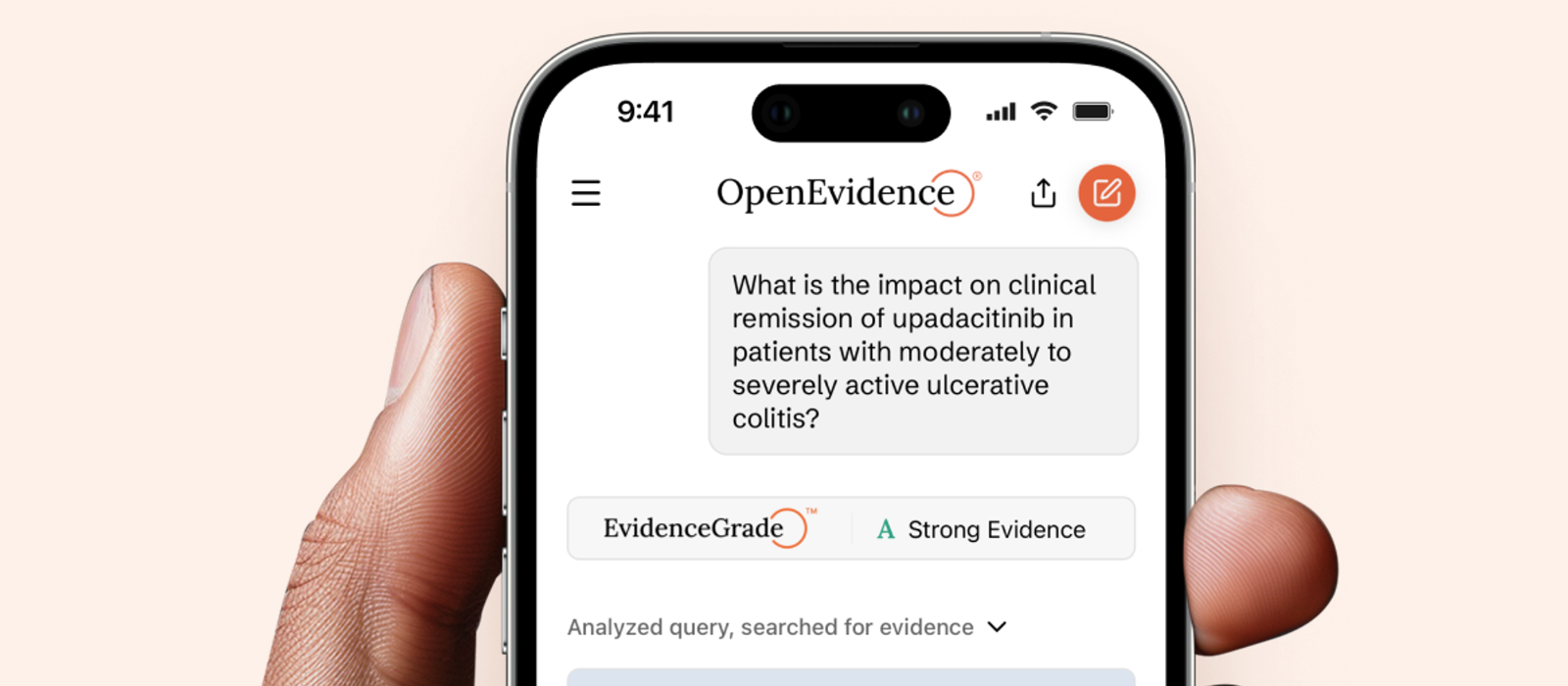
The first half of 2026 settled a question the industry has spent two years debating. Physician adoption of AI is no longer a “what if”, the question is now “which tools are earning a lasting place in clinical practice?”
In March, NPI-verified U.S. clinicians conducted one million clinical consultations on OpenEvidence in a single day.
As of July 2026, more than one million NPI-verified U.S. clinicians use OpenEvidence, including 65% of practicing physicians, asking 1.5 million queries a day and 35 million a month. Roughly 60,000 new clinicians sign up every month.
These milestones show AI has become part of the daily practice of medicine, supporting physicians as they review the evidence behind a treatment, compare therapies, check dosing and safety considerations, and work through unfamiliar presentations.
What Independent Research Shows
Internal adoption figures are only part of the story. Two independent studies help place them in context.
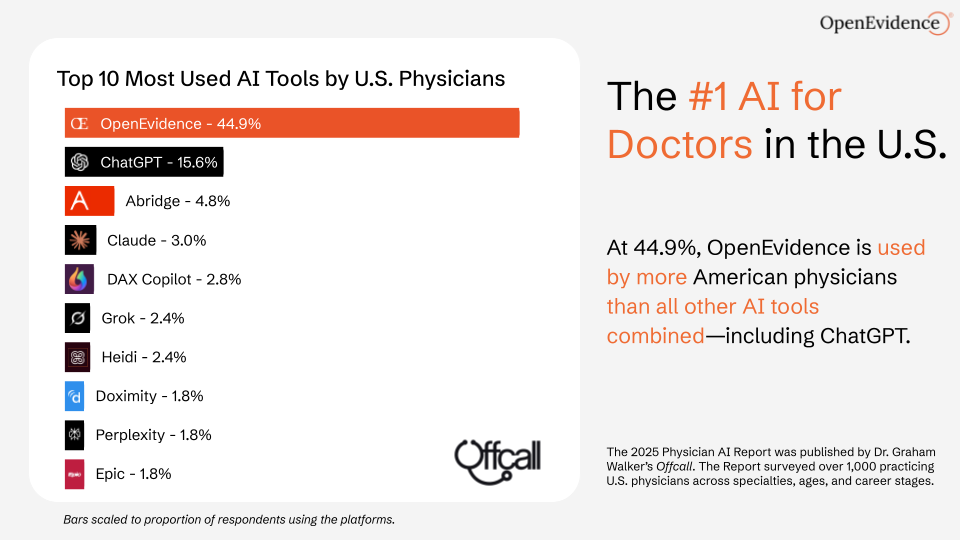
Offcall's 2025 Physicians AI Report surveyed more than 1,000 physicians across 106 specialties and found that 67% used AI in their daily work. Physicians reported using 71 different AI tools, reflecting a highly fragmented market. OpenEvidence accounted for 44.9% of reported usage, nearly three times ChatGPT's 15.6% share and more than all other AI tools combined.
The NOHARM study, updated in July 2026, offers a more recent view. Conducted by the ARISE clinical AI research network and led by physician researchers at Stanford University School of Medicine and Harvard Medical School, it observed physicians working through clinical cases. In one randomized arm, 101 board-certified U.S. physicians could use any outside clinical decision support tool they chose.
Among responses where physicians reached for an external AI tool, OpenEvidence accounted for 53% of usage. ChatGPT, Claude, Gemini, and every other general-purpose chatbot combined made up the remaining 47%.
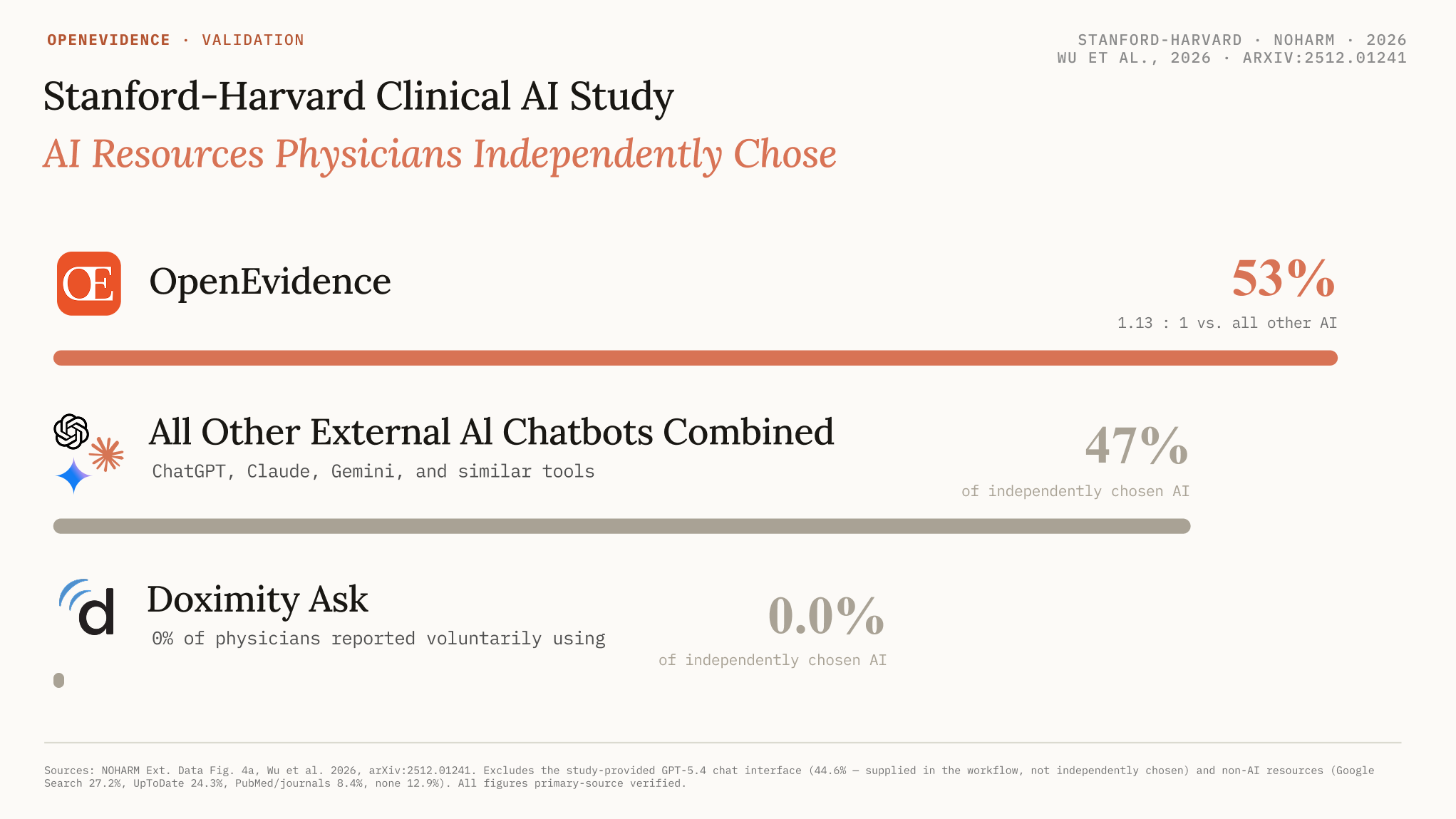
NOHARM has not yet been peer reviewed, and its benchmark findings should be read with that limitation in mind. However, this portion of the study captures something its benchmarking results miss: which tool a physician actually reaches for when practicing.
Read alongside the Offcall survey, the result points to a consistent pattern. Physicians are adopting AI quickly, but they are not treating every tool as interchangeable. They are turning to tools purpose-built for them — tools they can trust, designed specifically around clinical questions, medical literature, and evidence-based decision-making.
Built for Clinical Use
What separates the tools physicians keep using is whether the answers hold up under scrutiny.
OpenEvidence grounds every answer in the medical literature and links directly to the supporting references, so a physician can check the source. Partnerships with more than 300 of the world's leading medical journals, societies, and health systems widen that evidence base. Content partnerships with the New England Journal of Medicine, JAMA and its 11 specialty journals, the American Medical Association, the National Comprehensive Cancer Network (NCCN), and the American College of Cardiology, among others, provide full-text access to authoritative, peer-reviewed content, so answers in each therapeutic area draw on current, high-quality evidence.
OpenEvidence EvidenceGrade™ goes a step further. It applies the GRADE framework used by Cochrane, the WHO, and leading guideline developers to appraise the strength of the evidence behind an answer, giving physicians more context for interpreting what they are reading.
What This Means for Life Sciences
As clinical AI becomes part of everyday physician workflows, it is changing how medical information is found and how treatment options are compared, and that changes where brands can meaningfully engage.
That is a different environment from traditional digital media. Rather than pushing content toward physicians and hoping it lands when they are interested, content is pulled in response to a question the physician is asking. It pairs the intent of a search engine with the verified-prescriber audience of an HCP channel.
For life sciences brands, that is an opportunity to engage in the clinical context of the question itself, reaching physicians at the moment of clinical intent, while they are actively evaluating treatment options and making decisions for patients.